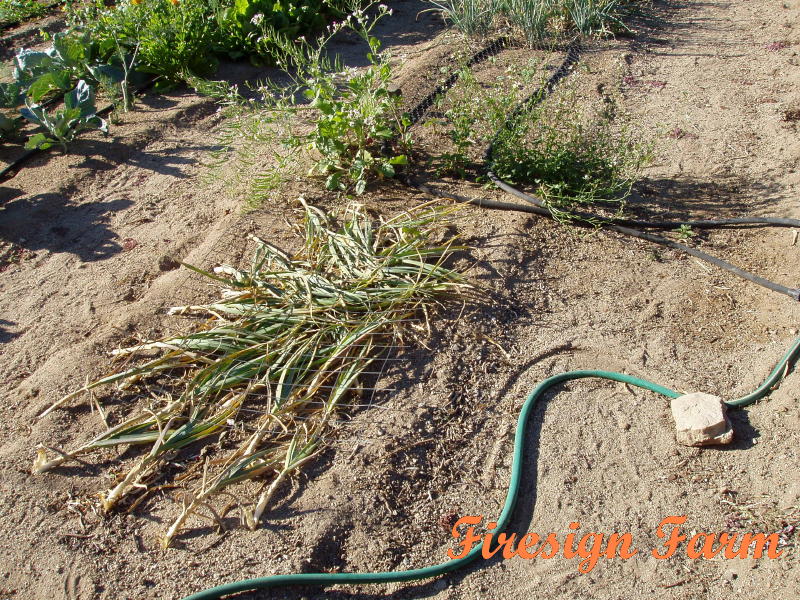
It was a breezy afternoon - just right for gathering lettuce seeds. Lettuce seeded in the Spring was harvested first as thinnings, then outer leaves here and there, and finally by cutting whole heads. When warmer weather finally arrived and the lettuce started to bolt, I pulled most of the plants incrementally to give to the chickens. But I also left a 3-5 plants of each variety to set seed.
So I've been watching those plants, waiting for just the right time to gather seeds. I knew it needed to be soon. I need to make sure they've had enough time to mature viable seeds. The seeds of Black-seeded Simpson, aptly named, are easy to see when
mature - nestled at the base of the fluffy little flower pods. But if I wait too long, the birds will beat me to them. High winds can blow the seeds away; rain can pound them off the plants.
The easiest way to get the most seeds, reasonably clean, is to just bend the plant tops over a tub and rub the seed pods between my hands. Old lettuce stalks produce a white sticky sap that irritates my skin, so I wear gloves. Each variety is in a separate space, carefully noted at planting time, so I harvest and process one variety at a time, but you could also create your own greens seed mix by just harvesting everything together.
After gathering, next comes the threshing. I rub the gathered seeds and chaff between my hands to break up any clumps. A coarse sieve filters out bigger immature buds and stems, and I pick out anything moving (no chemicals, so there is an occasional bug or worm).
Then, winnowing. I pour the seeds and chaff back and forth between two tubs. If it's really breezy, only a foot of pour space is enough; with less breeze I might go three feet high to pour. It's a bit scary to see how much stuff blows away at first, thinking you're losing all your seeds, but have faith.
The relatively high sides of the tubs keep bouncing out to a minimum. I sometimes blow directly on the chaff, hand-picking out of the far side of the tub. Before long, I have relatively clean seeds that can then be poured into envelopes (recycled, of course), labeled, and tucked away until next Spring. I pulled all the lettuce stalks and gave them to the chickens, and eventually they'll end up in this fall's compost pile.
Clockwise from top left: Ruby, Black-Seeded Simpson, Bibb, Buttercrunch, and Romaine. I also harvested dill and arugula seeds (not shown).
Showing posts with label the vegetable garden. Show all posts
Wednesday, September 4, 2013
Friday, March 8, 2013
Ordering Onions
Even though it's been snowing (lightly, I admit, and really welcome - pretty much all of our natural annual precipitation is from snow) the first yellow crocus are blooming. That's my signal that it's time to start thinking about getting the earliest garden bed ready to plant. Garlic and shallots, planted last fall, are now up about an inch. I didn't get around to sowing any spinach or arugula seeds back then, but I did leave a few plants that set seed to winter over, so I might get some volunteers anyway. I've gotten lots of questions from local gardeners regarding my success, so I'm going to try to write for northern Nevada gardeners to follow along. So, kids, do try this at home!
The weather is supposed to start warming up again tomorrow, so it looks like I get one more lazy day before it's time to get my hands back in the dirt! I ordered my onion plants yesterday. Now, you could get onion plants from your local garden center, but most of them won't get their plants in for a few more weeks yet. I suppose I could grow my onions from seeds, but I've never had much luck starting, then growing them to a decent size inside. Besides, seed-grown plants should have been started in early January, at least. The little bags of onion bulbs, called sets, are ok if you want scallions or a few small onions for fresh use, but for big onions you want a variety specific to your growing environment. To get my onion plants when I want them, the varieties I want, for the way I want to use them, I've found it best to order them online. I've been very happy with the service and quality at Dixondale Farms.
Each leaf on an onion plant makes a layer inside the bulb. The earlier and quicker your onion starts growing, the more leaves on the plant and that means a bigger, juicier onion bulb. So they need a rich soil that will hold water, but with enough drainage to keep it from getting soggy. Drainage is no problem in my garden's DG (decomposed granite) sand, so I concentrate on supplying enough nutrients and water-holding capacity. Aries was out a couple of days ago running last fall's compost pile through the shredder, rebuilding the pile, and wetting it down. A check with the thermometer this morning showed almost no heating up though, so it's pretty much ready to use. I also have a bin of leaf mold, made more than a year ago, that's slowly broken down to a third of what it was. Leaf mold doesn't contain much nutrients, but it's great for water retention.
My onion plants should be shipped next week - they base shipping dates by your zip code to get your onions to you at the optimum planting time for your specific area. I know from experience that they will stay dormant for a few weeks if kept cool and dry, if the weather isn't cooperative. But looking at the advance forecast, it's time to get busy! The entire early bed gets a light dusting of my all-purpose fertilizer mix (equal parts bone meal, blood meal, and greensand), a layer of finished compost, plus some of the leaf mold. I'll just lightly dig that into the top six inches (I just leave it as a top dressing where the shallots and garlic are already up), and rake smooth. Onions, especially, don't do well in competition with weeds, so I then will wet that down well (or maybe Mother Nature will do it for me) to get any weed seeds in the top inch of the soil to germinate. Over the next week or so, a very light going over with the stirrup hoe a couple of times will take out quite a few baby weedlings before the onions go in.

Onions switch from growing leaves to swelling into bulbs depending on the amount of daylight during the height of summer. I live right where Nevada makes that obtuse angle next to California. Looking at the Dixondale map, that's intermediate day onion territory. But I want the storage capabilities of the northern, long day, onions. So I compromise by ordering long day, long keeping onion varieties and then get them into the ground as early as I can with as much soil fertility as I can so they can grow as many leaves as possible before mid-summer. I ordered one bunch of Copra, the biggest and best-keeping onion I've found. And then I ordered a mixed variety sampler bunch (since you get a price break ordering more than one bunch, but two bunches is all I have room for) of long day onions. The Walla Walla grow great here - they get really big really fast, but then don't store at all. We start pulling and using them by early July, for fresh use as we need them, so they're usually all gone by early September. If you're not interesting storing your onions, grow the Walla Walla. By fall, we're using the Ringmasters, for fresh eating and then that's what I use in my fall tomato sauce and salsa canning recipes. We pick a few Redwings incrementally throughout the summer, whenever I want a red onion, and then those also store well into mid-winter.
The weather is supposed to start warming up again tomorrow, so it looks like I get one more lazy day before it's time to get my hands back in the dirt! I ordered my onion plants yesterday. Now, you could get onion plants from your local garden center, but most of them won't get their plants in for a few more weeks yet. I suppose I could grow my onions from seeds, but I've never had much luck starting, then growing them to a decent size inside. Besides, seed-grown plants should have been started in early January, at least. The little bags of onion bulbs, called sets, are ok if you want scallions or a few small onions for fresh use, but for big onions you want a variety specific to your growing environment. To get my onion plants when I want them, the varieties I want, for the way I want to use them, I've found it best to order them online. I've been very happy with the service and quality at Dixondale Farms.
Each leaf on an onion plant makes a layer inside the bulb. The earlier and quicker your onion starts growing, the more leaves on the plant and that means a bigger, juicier onion bulb. So they need a rich soil that will hold water, but with enough drainage to keep it from getting soggy. Drainage is no problem in my garden's DG (decomposed granite) sand, so I concentrate on supplying enough nutrients and water-holding capacity. Aries was out a couple of days ago running last fall's compost pile through the shredder, rebuilding the pile, and wetting it down. A check with the thermometer this morning showed almost no heating up though, so it's pretty much ready to use. I also have a bin of leaf mold, made more than a year ago, that's slowly broken down to a third of what it was. Leaf mold doesn't contain much nutrients, but it's great for water retention.
My onion plants should be shipped next week - they base shipping dates by your zip code to get your onions to you at the optimum planting time for your specific area. I know from experience that they will stay dormant for a few weeks if kept cool and dry, if the weather isn't cooperative. But looking at the advance forecast, it's time to get busy! The entire early bed gets a light dusting of my all-purpose fertilizer mix (equal parts bone meal, blood meal, and greensand), a layer of finished compost, plus some of the leaf mold. I'll just lightly dig that into the top six inches (I just leave it as a top dressing where the shallots and garlic are already up), and rake smooth. Onions, especially, don't do well in competition with weeds, so I then will wet that down well (or maybe Mother Nature will do it for me) to get any weed seeds in the top inch of the soil to germinate. Over the next week or so, a very light going over with the stirrup hoe a couple of times will take out quite a few baby weedlings before the onions go in.
Onions switch from growing leaves to swelling into bulbs depending on the amount of daylight during the height of summer. I live right where Nevada makes that obtuse angle next to California. Looking at the Dixondale map, that's intermediate day onion territory. But I want the storage capabilities of the northern, long day, onions. So I compromise by ordering long day, long keeping onion varieties and then get them into the ground as early as I can with as much soil fertility as I can so they can grow as many leaves as possible before mid-summer. I ordered one bunch of Copra, the biggest and best-keeping onion I've found. And then I ordered a mixed variety sampler bunch (since you get a price break ordering more than one bunch, but two bunches is all I have room for) of long day onions. The Walla Walla grow great here - they get really big really fast, but then don't store at all. We start pulling and using them by early July, for fresh use as we need them, so they're usually all gone by early September. If you're not interesting storing your onions, grow the Walla Walla. By fall, we're using the Ringmasters, for fresh eating and then that's what I use in my fall tomato sauce and salsa canning recipes. We pick a few Redwings incrementally throughout the summer, whenever I want a red onion, and then those also store well into mid-winter.
Thursday, November 3, 2011
Figs in Northern Nevada
I got out today, and gathered up the rest of my hoses. It was windy, but not too cold, so the hoses were still somewhat pliable. I don't have room to store them inside anywhere, so I coil them up into piles on a couple of pallets on the north side of the shed, and then cover them with a tarp for the winter.
The storm moving in tonight was expected to bring rain, turning to snow before morning. I took a gamble, that it won't get too cold, and left the fig trees out. Please note: figs are not a normal plant for this area. I inherited my two potted trees about 10 years ago, and have been babying them ever since.
They can take temps down to about 25F before it kills the top growth. I know that because I lost the trunks once, but the roots survived. This time of year, I put the pots in the wagon and move them into the garage on the really cold nights. But all the nights are getting too cold now, and I need them to finally go dormant. I don't want to just pull the leaves off. I want to make sure the tree gets the signals that it's time to drop its leaves and shut down for the winter. Then I can move them down into the cellar until spring.
I'm also chancing losing my chard and kale, as I left them uncovered tonight too. They can take it down to about 25F as well, so I'll be checking the min/max thermometer first thing tomorrow morning. I'm hoping the cloud cover from the storm moderates the cold tonight.
They can take temps down to about 25F before it kills the top growth. I know that because I lost the trunks once, but the roots survived. This time of year, I put the pots in the wagon and move them into the garage on the really cold nights. But all the nights are getting too cold now, and I need them to finally go dormant. I don't want to just pull the leaves off. I want to make sure the tree gets the signals that it's time to drop its leaves and shut down for the winter. Then I can move them down into the cellar until spring.
I'm also chancing losing my chard and kale, as I left them uncovered tonight too. They can take it down to about 25F as well, so I'll be checking the min/max thermometer first thing tomorrow morning. I'm hoping the cloud cover from the storm moderates the cold tonight.
Wednesday, November 2, 2011
Garden Update
We've shut down and drained the yard water system. I got some clean-up work done out in the garden this afternoon - rolling up hoses, stacking wire cages, and storing the metal stakes. I still have to figure out where to put the chicken wire I use to protect newly seeded areas, and still have hoses out around the fruit trees that need to be stored. Low temperature last night was 15F so I now have a few more dead plants to pull, but it's looking pretty good.
Aries has been filling up the compost bins - raking and shredding leaves as they fall, mixing them in with chicken manure. He has some finished compost for me too. I got half of next year's Early Bed composted and raked smooth last week. Today, I planted next year's garlic and shallots, and broadcast some arugula and spinach seeds to winter over.
In the Late Bed, I'm trying to stretch my fresh eating out of the garden a little bit longer. I leaned a couple of pieces of wire together above the Swiss chard, put tomato cages over the Tuscan kale, and a wire frame over the radicchio, and have been covering them when the temps drop into the teens. Rain, turning to snow, is forecast tomorrow evening into Friday. I think I'll pull the covers tomorrow, so everything can get watered and the draperies stay dry, and then put them back on Friday when it's supposed to get really cold for a couple more days. I thought about digging a few plants and putting them down in the cellar, but I don't want to take the chance of introducing an aphid infestation, so I'm not going to bother. I might get a few straw bales and rig up a cold frame out of some old windows though.
I harvested the last of the cabbages, broccoli, and cauliflower, but left the plants. The cabbage stumps froze, but the others still look ok. I've made a note for next year that the leeks should be in the Late Bed instead of with the other alliums. They looked pathetic late this summer, after I broke off the seed stalks, but now they're gorgeous and just keep getting bigger. And they'll still be fresh eating, no problem, in February.
Aries has been filling up the compost bins - raking and shredding leaves as they fall, mixing them in with chicken manure. He has some finished compost for me too. I got half of next year's Early Bed composted and raked smooth last week. Today, I planted next year's garlic and shallots, and broadcast some arugula and spinach seeds to winter over.
Friday, October 14, 2011
Growing Okra in Northern Nevada
I usually start a couple of okra seeds inside in April, the same time I start my tomatoes, eggplants, and peppers. Sometimes they'll take forever to sprout, sometimes the seeds are up and growing quickly. Often they'll get too big and die back before the weather gets warm enough for them. The young plants are super-tender too. I've had little okra plants freeze inside their Wall-o-waters when nothing else was even fazed. They can really tricky to harden off and transplant even when the weather does warm up.
This spring, I started seeds twice, and both times they died before even making it into the garden. I just figured I wouldn't have any okra this year (again). Then, in early July, I had a bit of empty space after I cleared out some early greens. I thought I'd try direct-seeding six Clemson Spineless seeds - it was certainly hot enough by then that maybe they'd germinate outside. The seed packet said 60 days to harvest. If the fall freezes held off 'til mid-September, I just might get a few pods.
All six germinated, and grew quickly. By the end of September, I had a little over a quart of pods in the freezer - enough for maybe three batches of my favorite lentil & okra stew this winter. I was pleasantly surprised that I got anything at all.
The first week of October, when the night temps dropped into the 20's, I figured that was it. I picked all the okra pods, but didn't pull the plants. I figured I'd get around to it after they froze. They didn't freeze! The last cucumber and squash plants are all shriveled; the last bit of basil black and crispy; the tomato and chile plants are already in the compost bin. After struggling to keep the extremely tender young okra plants alive each spring, I'm amazed to see that these mature plants are STILL blooming and growing strong into late October. Who knew? From now on, okra will be a mid-summer into fall plant in this northern Nevada garden.
All six germinated, and grew quickly. By the end of September, I had a little over a quart of pods in the freezer - enough for maybe three batches of my favorite lentil & okra stew this winter. I was pleasantly surprised that I got anything at all.
Thursday, September 8, 2011
Curing Onions
I'd pulled the soaker hoses off the rest of the onions a few weeks ago, and bent down those tops still upright. After a couple of weeks of drying and dying, I used a garden fork to loosen the soil, then my hands to scoop up the bulbs. I then wheeled them into the shade up by the house to cure.
Onions need to be cured for storage. Set out in a single layer in a warm and airy spot, the roots die, the neck shrinks down, and the outer-most layers dry and toughen up. Properly cured yellow Copra onions, I've found, will successfully store for close to a year - easily until the following July. Of my long-day sampler bunch trials, the Walla Wallas are already harvested and in the kitchen, as they'll only hold for a month. Of the rest of that bunch, the white Ringmasters should store up to 4 months and the Red Zeppelins six to eight. I've liked having some red onions this year. I've been using them in the kitchen throughout the summer. I'm also very interested in seeing how the Ringmasters hold up in storage. They produced some beautiful big bulbs with small necks (necessary for good storage potential), and more importantly are an open-pollinated variety (as opposed to a hybrid). I might replant one or two of those late this fall, to let go to seed next year. Onion self-sufficiency is an eventual goal of mine.
Our weather is gradually sliding towards fall. Days are still quite warm though, and the nights cooler but still nice enough to sleep with the windows open. Last night, I hadn't been asleep long when I awakened to the pitty-pat sound of raindrops. Oh no, if the onions got soaked it would ruin their curing. I got out of bed and grabbed a vinyl tablecloth from the camping gear in the closet. The rain had just started; the tree had kept most of the water off the onions. Quickly tucking the doubled tablecloth around the onions, I went back to bed. When the flash of a full-on booming thunderstorm woke me again a little later, I just smiled and went back to sleep. My onions were safe. The next morning, I uncovered them before the day warmed up. If I'd left them under the waterproof cover, they'd have started to sweat, also threatening the curing process. With a slight chance of thunderstorms this upcoming week, I thought it best to move the onions into the garage. I can open up the doors to let the air move through, and not have to worry about any storms coming though when I'm not at home.
Onions need to be cured for storage. Set out in a single layer in a warm and airy spot, the roots die, the neck shrinks down, and the outer-most layers dry and toughen up. Properly cured yellow Copra onions, I've found, will successfully store for close to a year - easily until the following July. Of my long-day sampler bunch trials, the Walla Wallas are already harvested and in the kitchen, as they'll only hold for a month. Of the rest of that bunch, the white Ringmasters should store up to 4 months and the Red Zeppelins six to eight. I've liked having some red onions this year. I've been using them in the kitchen throughout the summer. I'm also very interested in seeing how the Ringmasters hold up in storage. They produced some beautiful big bulbs with small necks (necessary for good storage potential), and more importantly are an open-pollinated variety (as opposed to a hybrid). I might replant one or two of those late this fall, to let go to seed next year. Onion self-sufficiency is an eventual goal of mine.
Monday, September 5, 2011
My Garden Chair
I think every garden, no matter how large or small, needs a place to sit. Maybe just as a place to rest a bit, or your spot to enjoy the sights and sounds of nature, or maybe it's a secret hideaway. It could be a folding chair, the tailgate of a truck, an old bench, an upright chunk of log, a low stool underneath a bean teepee, or maybe even a swing. Extra points if you also have a table close by - a place to set a cold drink, seeds and tools, your gathering basket, maybe even a radio.
I have an old cast-aluminum chair just inside my garden gate, next to an old cable spool that serves as a table. The plastic arms cracked apart from the sun years ago, but once I removed the screws holding the shattered bits the metal arms were quite comfortable. Then, the cheap cushion I had on it finally fell irreparably apart last season. However, I could still sit on the metal frame, so that's what I've been doing. It wasn't very comfortable though, and a bit too low besides.
Then, a couple of days ago I rediscovered a slab of foam up in the rafters of the shed - and it was just the right size for a new chair cushion. We have a mill ends fabric store in town, so I stopped by to check prices and their stock of outdoor canvas (aka Sunbrella). A beautiful floral stripe remnant caught my eye right away, and amazingly it turned out to be just big enough (plus, perfectly sized to be able to center the flower part on both front and reverse sides, back and seat, too). Isn't it wonderful when things work out so perfectly? Ten dollars spent, an afternoon spent sewing, and once again I have a comfortable place to sit while out in my garden.
I have an old cast-aluminum chair just inside my garden gate, next to an old cable spool that serves as a table. The plastic arms cracked apart from the sun years ago, but once I removed the screws holding the shattered bits the metal arms were quite comfortable. Then, the cheap cushion I had on it finally fell irreparably apart last season. However, I could still sit on the metal frame, so that's what I've been doing. It wasn't very comfortable though, and a bit too low besides.
Sunday, September 4, 2011
Walla Walla Onion Harvest
I'm very happy with my Walla Walla onion trial this year. The plants, ordered in February, received mid-March, and planted in early April, did very well for me.
According to the Dixondale day-length map, I'm in the middle of the intermediate-day section. I went with the long-day onions because most of those varieties have a longer storage time. The storage potential of the Walla Walla, at approximately one month, is the shortest of those I grew this year. Knowing this, I've been using them fresh out of the garden for the past couple of months. The tops were the first to fall over, so I harvested the rest of the Walla Walla onions a couple of weeks ago.
The Walla Walla were one-third of a long-day sampler bunch, supposed to do ok here if planted early enough. Despite pulling some for fresh use throughout the latter part of the summer, after trimming and curing I ended up with almost 14 pounds of Walla Walla onions. I've been using the smaller and thick-necked ones in daily cooking, and hung the rest in a net bag in the pantry for short-term storage. Even though they have a rather thin wrapper layer, they should keep until the tomatoes and tomatillos are ready to start canning sauce and salsa.
Wednesday, July 13, 2011
Bending Down the Garlic
I'm having some successes, and some failures out in the garden. That's usually the case around here, too. The garlic is looking good. The tips of the leaves were starting to dry up. When the top one-quarter had dried, a couple of days ago, I pulled the soaker hoses off and bent the tops over. Sometimes they'll just fall over on their own, but if they don't by the time 1/4 to 1/3 of the leaf tips has browned I do it for them. If you wait too long, until most of the leaves have dried, they'll be too dry and rattley to form a nice snug wrapping layer around the bulb when cured, and then they won't last very well.
Bending them over now tells the plant to pull the last of the energy out of the fading green leaves and store it in the bulb. Removing the water hose also tells them it's time to concentrate and shut down for the season. I'll give them a couple more days of drying out in the ground, letting the necks shrink a bit. And then dig them up before the leaves get too dry and brittle to braid.
I've been so busy lately. I do so enjoy writing, but so many other things just had to be done first. I was installed as President of my local Soroptimist Club three weeks ago, and have been trying to get organized - committees appointed, and finding the people to chair them; creating the agenda and supporting materials for my first Board of Directors' meeting, and then today for my first Club meeting; brushing up on my Parliamentary procedures; and even inducting a couple of new members. Add in one of our major fundraisers - taking my turn in our tasting kit booth for an International Chili Cookoff, plus the training session as a volunteer for the Lake Tahoe Shakespeare Festival . . . ahh, but enough whining - I do love everything that I'm a part of here in my community.
Tuesday, May 17, 2011
Thinning and Transplanting
A series of cold fronts coming through dropped our low night temperatures into the mid 20'sF. While once again frustrating my dreams of a bountiful fruit crop this year, it is completely normal for high-desert weather in mid-May (and sometimes, even for mid-June, perish the thought). What little bit - lettuces, spinach, peas, and alliums - I have growing out in the vegetable garden seems to have come through ok so far.
I haven't set out my cole crops - broccoli, cauliflower, cabbages, choi, radicchio, and tuscan kale - but plan to do so within the next week. Most catalogs say to plant very early for a Spring harvest; again in early August for a Fall harvest. I've never had any luck with that. I just plant everything once and hope to stretch the harvest season until October through varying the length of growth periods on some things (like cabbage - I plant both an early and a late variety), and cut-and-come-again harvests on others (like the kale and broccoli).
I did some thinning and transplanting of the cole seedlings a couple of weeks ago, writing about that here, on the SGF Co-op blog. Since then, I've been hardening them off - moving them out to the table on the deck daily, bringing them back in to the kitchen counter at night. I now have some sturdy little plants with separate, compact root balls to set out.
Yesterday, I thinned and transplanted my warm weather seedlings. Even though the night before had been cold, the temperature warmed up to a nice 60F. Overcast and still, with no bright sun or drying winds to crispify the roots, the operation took place outside on a big salvaged cable spool I use as a potting table. Even so, I tried to move quickly whenever I had the roots of any tiny seedling exposed. Some looked a bit poorly and limp as I moved them back inside, under the lights (my temporary setup: a pair of ladderback chairs, a plank, and lights suspended by a couple of curtain rods), but all had perked right up by this morning.
Some of my seeds never did germinate. I ended up shopping for a few plants this weekend - more bell peppers, plus some eggplants, Anaheim chiles, one Habanero chile, and one Sweet 100 tomato. To save money when I buy plants, I look for the little individual pots with more than one plant growing in them, and then separate them out myself, same as I do with my own seedlings. I'll give everything another week or so under the lights, to give the roots time to re-establish. Another week or two of gradually increasing hardening off out on the deck, and everything should be ready to set out in early June.
I haven't set out my cole crops - broccoli, cauliflower, cabbages, choi, radicchio, and tuscan kale - but plan to do so within the next week. Most catalogs say to plant very early for a Spring harvest; again in early August for a Fall harvest. I've never had any luck with that. I just plant everything once and hope to stretch the harvest season until October through varying the length of growth periods on some things (like cabbage - I plant both an early and a late variety), and cut-and-come-again harvests on others (like the kale and broccoli).
Tuesday, April 5, 2011
Varieties for Northern Nevada Gardens
I got my indoor seeds planted today. I've found eight to ten weeks is long enough to get everything up and growing and hardened off, ready to plant. Since I won't plant any of them outside until after Memorial Day, today was a fine time to get them started. They won't be as big as the plants you can buy in the garden shops in May. But I think my smaller plants undergo less transplant shock, and do catch up quickly once the warm weather gets here. More about the process here.
Those of you following along at home, start saving your eggshells, too. I just keep mine in an open jar under the kitchen counter. They dry out, so don't smell or attract ants. When the jar gets full, I use a potato masher to crush them down. When it's time to set my tomatoes, peppers, chiles, and eggplants out in the garden, I add some eggshell (calcium) and Epsom salts (magnesium) to the planting hole to prevent blossom end rot. It's a good idea to pick up some Wall-o-Waters if you see them in the store, too. I reuse the same ones year after year. I put them around my plants when I set them out, and leave them on until July. They both keep the plants warmer at night and provide protection from our notorious Washoe Zephyr.
Most years, we can count on around a 100-day growing season for our tender crops. Pass up those Brandywine tomatoes, and go for the Early Girls if like eating home-grown ripe tomatoes. Here's what I started today - varieties I've found that usually will produce a pretty good harvest in our high-desert climate. Many of these can be found in the seed racks at Wal-Mart or any of the grocery stores. This is enough for the two of us to eat fresh, put by for the winter, and still have some extras to give away:
1 Early Girl tomato - the most reliable, fresh-eatin' tomato
1 Sweet 100 tomato - for snacking on, right there next to the plant
6 CC (for Carson City) Paste tomatoes; to can, slices to dry, plus they'll also store until after New Year's - I started with an Amish Paste tomato 25 years ago. I kept saving seeds from the biggest, earliest couple of tomatoes each year, and now have my own "heirloom" that reliably produces big, early, bunches of tomatoes. I don't bother with the fermenting-seeds-in-water bit everyone tells you to do - I just cut the fruit open, squoosh the seedy gel out with my finger, and wipe it onto a piece of paper. When dry, I fold up the paper and store it in an envelope in my seed box. When it's time to plant, I just scratch the seeds off the paper and stick 'em in the dirt.
6 CC Chile peppers - same story - I started with an Anaheim/California green chile years ago, and saved the seeds from the biggest, earliest couple of fruits each year
6 California Wonder bell peppers - still working on getting a good, early bell pepper. This is an heirloom so has some good possibilities
6 Jalapeno peppers - up from my usual two plants. The jalapeno jelly I made last year is soooo good, I want to make sure I have enough plants to make a batch or even two this year. If I end up with a bumper crop, it's easy to put together a smoker to make chipotles - maybe I'll try canning a batch in adobo.
6 Ancho chile peppers - the additional chile for this year. Every year, I grow and dry or can enough of one different chile - cayenne, paprika, relleno, pimiento, etc. - to last for the next 3-4 years. I just broke open one of last Ancho I grew, strung up in a ristra hanging in my kitchen, and planted those seeds. They should still be viable.
1 Habanero pepper - I usually end up buying a plant at the store. If I want to grow my own, I should probably start it in January instead of waiting until now. One plant will usually produce enough to make a batch of my favorite hot sauce each year.
2 Clemson Spineless okra - yes, you can grow okra here. And why deal with spines if you don't have to? It's an heirloom variety, but I've never managed to save viable seeds so I buy a packet every few years.
3 Black Beauty eggplant - I like them better than the Japanese type, plus they'll last in storage 'til the first of the year. Same as the okra, it's an heirloom variety, but I've never managed to save viable seeds.
2 basil - enough to eat fresh, dry some, plus freeze a few batches of pesto, too
2 green tomatillos - last year, I just picked out the biggest fresh tomatillo I could find in the grocery store, and did the same squoosh-the-seeds-onto-paper that I do for tomatoes. I got a nice harvest of good-sized tomatillos, and saved the seeds from the biggest, earliest ones to plant this year.
I also started six-packs of early Golden Acre cabbage, late Dutch Ballhead cabbage, broccoli, cauliflower, raddichio, Joi Choi, Tuscan kale, and both orange and yellow calendulas, plus a couple chard, red kale, and blue kale plants. But those are all cold-hardy veggies, so just about any variety of those plants will do ok here. All of those will get set out the end of May too, to grow through the summer for a fall harvest.
Those of you following along at home, start saving your eggshells, too. I just keep mine in an open jar under the kitchen counter. They dry out, so don't smell or attract ants. When the jar gets full, I use a potato masher to crush them down. When it's time to set my tomatoes, peppers, chiles, and eggplants out in the garden, I add some eggshell (calcium) and Epsom salts (magnesium) to the planting hole to prevent blossom end rot. It's a good idea to pick up some Wall-o-Waters if you see them in the store, too. I reuse the same ones year after year. I put them around my plants when I set them out, and leave them on until July. They both keep the plants warmer at night and provide protection from our notorious Washoe Zephyr.
1 Early Girl tomato - the most reliable, fresh-eatin' tomato
1 Sweet 100 tomato - for snacking on, right there next to the plant
6 CC (for Carson City) Paste tomatoes; to can, slices to dry, plus they'll also store until after New Year's - I started with an Amish Paste tomato 25 years ago. I kept saving seeds from the biggest, earliest couple of tomatoes each year, and now have my own "heirloom" that reliably produces big, early, bunches of tomatoes. I don't bother with the fermenting-seeds-in-water bit everyone tells you to do - I just cut the fruit open, squoosh the seedy gel out with my finger, and wipe it onto a piece of paper. When dry, I fold up the paper and store it in an envelope in my seed box. When it's time to plant, I just scratch the seeds off the paper and stick 'em in the dirt.
6 California Wonder bell peppers - still working on getting a good, early bell pepper. This is an heirloom so has some good possibilities
6 Jalapeno peppers - up from my usual two plants. The jalapeno jelly I made last year is soooo good, I want to make sure I have enough plants to make a batch or even two this year. If I end up with a bumper crop, it's easy to put together a smoker to make chipotles - maybe I'll try canning a batch in adobo.
6 Ancho chile peppers - the additional chile for this year. Every year, I grow and dry or can enough of one different chile - cayenne, paprika, relleno, pimiento, etc. - to last for the next 3-4 years. I just broke open one of last Ancho I grew, strung up in a ristra hanging in my kitchen, and planted those seeds. They should still be viable.
1 Habanero pepper - I usually end up buying a plant at the store. If I want to grow my own, I should probably start it in January instead of waiting until now. One plant will usually produce enough to make a batch of my favorite hot sauce each year.
2 Clemson Spineless okra - yes, you can grow okra here. And why deal with spines if you don't have to? It's an heirloom variety, but I've never managed to save viable seeds so I buy a packet every few years.
3 Black Beauty eggplant - I like them better than the Japanese type, plus they'll last in storage 'til the first of the year. Same as the okra, it's an heirloom variety, but I've never managed to save viable seeds.
2 basil - enough to eat fresh, dry some, plus freeze a few batches of pesto, too
2 green tomatillos - last year, I just picked out the biggest fresh tomatillo I could find in the grocery store, and did the same squoosh-the-seeds-onto-paper that I do for tomatoes. I got a nice harvest of good-sized tomatillos, and saved the seeds from the biggest, earliest ones to plant this year.
I also started six-packs of early Golden Acre cabbage, late Dutch Ballhead cabbage, broccoli, cauliflower, raddichio, Joi Choi, Tuscan kale, and both orange and yellow calendulas, plus a couple chard, red kale, and blue kale plants. But those are all cold-hardy veggies, so just about any variety of those plants will do ok here. All of those will get set out the end of May too, to grow through the summer for a fall harvest.
Monday, April 4, 2011
Garden Remodel, Still in Progress
The plan for today was to get my seeds started inside. But when Aries' planned outing got canceled, I changed my plans in order to take advantage of the nice weather, superior muscles and horsepower now available. I got him to help me finish the garden reconfiguration.
I've been working on this project for a year - starting with moving the chicken coop, so we could move the garden fence, and re-working the lower two squarish beds into three long ones. I'd moved the raspberry patch last week, so had only to dig up the little patch of baby leeks, bunching, and walking onions. While I did that, Aries got the big rototiller fueled up and running, and brought it down to the garden. Luckily, a friend stopped by to visit him just then, so it gave me some time (ah, the dynamics of two fire signs working together - there can be sparks, but we do get things done) to get some stakes and string laid out to show him what should be garden bed and what should be path.
Our entire property drops down towards the east. He had to really work to keep that big tiller moving across the slope when it wanted to swing downhill, but he did pretty good keeping it lined up reasonably straight. Once tilled, he started hauling wheelbarrow loads of compost down from the bin up by the garage (he thinks it's easier to move the spent plants and chicken manure up, and the compost down, than moving the chipper-shredder very far from the garage). I spread the compost evenly over each bed, and then he ran through each one again. I'm still going to have to do some hand-digging along the edges of each bed, and a lot of raking to get them all into level terraces. But it's looking good.
I've been working on this project for a year - starting with moving the chicken coop, so we could move the garden fence, and re-working the lower two squarish beds into three long ones. I'd moved the raspberry patch last week, so had only to dig up the little patch of baby leeks, bunching, and walking onions. While I did that, Aries got the big rototiller fueled up and running, and brought it down to the garden. Luckily, a friend stopped by to visit him just then, so it gave me some time (ah, the dynamics of two fire signs working together - there can be sparks, but we do get things done) to get some stakes and string laid out to show him what should be garden bed and what should be path.
Sunday, April 3, 2011
Seed Starter Mix
It's time to start tender seedlings inside, to be set out in the garden after Memorial Day. But I was out of my seed starter mix, so today I made up a batch. Regular potting soil is too coarse, and doesn't hold enough water to get seedlings off to a good start. Curious, I looked at the tiny bags of seed starter mix in my local home improvement store. Not only would buying enough for my needs be prohibitively expensive, but I really don't think using something that, in reading the small print on the back, cautions that it's important to wear gloves while using this product, keep it away from children, and write to them to find out more about the metals (metal??) it contains. That just sounds chemical-laden to me. I'll continue to mix up my own, thank you.

Seed Starter Mix
3 parts compost
3 parts sphagnum peat moss (or coir fiber)
1 part vermiculite (or perlite)
a dusting of fertilizer booster blend (equal parts bonemeal, bloodmeal, & greensand)
I bought a bale of compressed peat moss at Wal-Mart, and big bag of vermiculite at Home Depot. Both are enough to last me for another 5-6 years of planting seasons. The compost and fertilizer blend I already had.
My compost is completely cooked, but still pretty coarse, so I had Aries run me a bin-ful through the chipper/shredder. Better, but still too coarse for little broccoli seeds. But once I sifted everything though a riddle, I had a wonderfully fluffy, fine-textured mix. It was easy to mix everything together with a trowel.
It's important to get the mix evenly damp before planting. The moss holds water well, but once it dries out, it's hard to get the moss re-hydrated again without disturbing the seeds. Wheeling it over to the faucet, I ran enough water into the wheelbarrow to make a soupy mess, and left it for a few minutes. When I came back, the moss had soaked up everything but there were still dry spots underneath. I kept adding water, stirring with a short-handled shovel, and waiting a bit, until everything was evenly damp.
Using compost, I probably won't have any pathogens or molds in this mix, but just to be on the safe side I solar-sterilized it. An old salvaged storm window was the perfect size to fit over the wheelbarrow. Weighting the glass down snug, with an old rug and a wadded-up feed bag tucked into the spaces top and bottom, I left the whole thing sitting in the sun all afternoon. Despite the somewhat cool temperatures today, the glass started steaming up almost immediately. This evening, I'll fill up my seed starter bin and bring it into the house so it doesn't freeze overnight. And tomorrow, I can plant my seeds!
Seed Starter Mix
3 parts compost
3 parts sphagnum peat moss (or coir fiber)
1 part vermiculite (or perlite)
a dusting of fertilizer booster blend (equal parts bonemeal, bloodmeal, & greensand)
I bought a bale of compressed peat moss at Wal-Mart, and big bag of vermiculite at Home Depot. Both are enough to last me for another 5-6 years of planting seasons. The compost and fertilizer blend I already had.
Saturday, April 2, 2011
Planting Day for Cold-Tolerant Seeds
The earliest daffodils are blooming, and now today, the Shiro plum tree. A couple of blooms have opened on the apricot. Buds are swelling on the rest of the plums, and leaves just starting to show on the lilacs and the maple tree. It's starting to look like Spring!
Yesterday evening, I finished digging and shaping two of my garden beds, and laid out the soaker hoses. So today was early season planting day. The onion plants were still dormant, down in the cool cellar. It's a bit damp down there, and a few of the tops had a bit of fluffy, grey mold on the tips. So, using my kitchen shears, I clipped about half an inch from the top of each bunch. Once outside in the wind and the sun, they should be fine.
With six garden beds to play with now, I've had to do some figuring and planning of how I want to divide up my plantings, and how my rotation will work. One long bed will now be the Allium bed, with a couple of little bits for the earliest greens harvests interspersed. It gets a dual soaker hose setup. My softneck garlic, from bulbs harvested last July then planted last fall, is already up about four inches, and green tips of the shallots are just starting to poke up out of the ground. I had scattered some spinach and arugula seeds in a block between those two last fall. They germinated in January but then shriveled in the dry eight weeks that followed. Ah well, sometimes that works, and sometimes it doesn't. So today I seeded some more arugula (my seeds, harvested last summer) in half of that area and some Champion and Salad Red radishes in the other half.
On the other end of the bed, I set out one bunch of Copra onion plants, plus a mixed bunch of Red Zeppelin, Ringmaster, and Walla Walla plants. I dug a couple of bunches of baby leeks from my allium nursery bed, and set each one into a hole the depth of my trowel (taking the time to hand-dig the entire bed this past week makes it so easy to plant everything today). In the last little patch of that bed, I scattered some Bloomsdale Long-Standing spinach seeds, harvested from last year's plants.
The second long bed will be a Peas and Greens bed - also with dual soaker hoses. I made three pea trellises, pieces of wire fencing attached with twist ties to t-posts pounded into the center of the bed. Despite what they say on the seed packets, I don't think you can plant peas too thickly. I dig a 3" wide trench on either side of the trellis and then scatter in the seeds about half an inch apart. I planted Sugar Snap peas around one trellis, Lincoln English peas around another and, for the Chinese pea pods, Melting Sugar on one side and Oregon Sugar on the other. All the peas are heirloom open-pollinated varieties, so I can save seeds for future plantings.
I've found that planting lettuces on the outside edges of the pea plantings works well. As the weather gets warmer, the growing peas provide shade for the lettuces, and the shade from the lettuces keeps the pea roots cooler, prolonging the harvests of both crops. I planted Romaine, Four Seasons, Buttercrunch, and a Gourmet mix of lettuces (also all open-pollinated) on either side of the Snap and Chinese pea plantings. I'm going to start some Tuscan kale plants inside to set out alongside the English peas.
I seeded some Swiss Chard and the last of my Joi Choi seeds in one patch between two trellises. I need to order some more Joi Choi seeds. It's a hybrid but it's the only bok choi I've found that can take the heat of our high-desert summer without bolting, so worth searching out (I get it from Jung Seeds). The rest of that bed I left open for cauliflower, cabbage, and broccoli transplants.
Yesterday evening, I finished digging and shaping two of my garden beds, and laid out the soaker hoses. So today was early season planting day. The onion plants were still dormant, down in the cool cellar. It's a bit damp down there, and a few of the tops had a bit of fluffy, grey mold on the tips. So, using my kitchen shears, I clipped about half an inch from the top of each bunch. Once outside in the wind and the sun, they should be fine.
With six garden beds to play with now, I've had to do some figuring and planning of how I want to divide up my plantings, and how my rotation will work. One long bed will now be the Allium bed, with a couple of little bits for the earliest greens harvests interspersed. It gets a dual soaker hose setup. My softneck garlic, from bulbs harvested last July then planted last fall, is already up about four inches, and green tips of the shallots are just starting to poke up out of the ground. I had scattered some spinach and arugula seeds in a block between those two last fall. They germinated in January but then shriveled in the dry eight weeks that followed. Ah well, sometimes that works, and sometimes it doesn't. So today I seeded some more arugula (my seeds, harvested last summer) in half of that area and some Champion and Salad Red radishes in the other half.
On the other end of the bed, I set out one bunch of Copra onion plants, plus a mixed bunch of Red Zeppelin, Ringmaster, and Walla Walla plants. I dug a couple of bunches of baby leeks from my allium nursery bed, and set each one into a hole the depth of my trowel (taking the time to hand-dig the entire bed this past week makes it so easy to plant everything today). In the last little patch of that bed, I scattered some Bloomsdale Long-Standing spinach seeds, harvested from last year's plants.
I've found that planting lettuces on the outside edges of the pea plantings works well. As the weather gets warmer, the growing peas provide shade for the lettuces, and the shade from the lettuces keeps the pea roots cooler, prolonging the harvests of both crops. I planted Romaine, Four Seasons, Buttercrunch, and a Gourmet mix of lettuces (also all open-pollinated) on either side of the Snap and Chinese pea plantings. I'm going to start some Tuscan kale plants inside to set out alongside the English peas.
I seeded some Swiss Chard and the last of my Joi Choi seeds in one patch between two trellises. I need to order some more Joi Choi seeds. It's a hybrid but it's the only bok choi I've found that can take the heat of our high-desert summer without bolting, so worth searching out (I get it from Jung Seeds). The rest of that bed I left open for cauliflower, cabbage, and broccoli transplants.
Wednesday, March 23, 2011
It's Spring?
The only spot of color outside my windows are the finches sheltering underneath the snow on the bare branches of the lilac. But I have faith that Spring weather will come eventually. So it's time to start thinking about the garden.
My onion order arrived last week, but I haven't even been able to get out to the garden yet. Depending on which day it is in our current weather cycle of the past three weeks, it's either too wet or the ground is frozen or it's buried beneath a couple inches of snow once again. But the info sheet said the onion plants will stay dormant for at least 3 more weeks if kept cool and dry, so I've put them down in the cellar for now.
There are lots of gardening things to get started on now, even when I can't get outside. For my fellow northern Nevada gardeners, I'll try to get back on a regular posting schedule so you can all follow along. Plus, I've been taking photos all along, so might do some back posts so I can look back to see what was happening when. Look on the bright side - the longer it keeps snowing, the better the chance the fruit trees will hold off blooming long enough to get some fruit later this summer.
Saturday, February 12, 2011
My Onion Order
Onions end up in just about everything I cook for dinner, quite often in breakfasts too, and many of my canning recipes. Despite numerous attempts, I've never been able to grow decent onions from seed. They'll sprout but just never have done very well for me, if they survive until the setting-out stage at all. So then I'd end up buying a couple of the little bags of onion sets, the miniature bulbs you plant in the early spring to get bigger bulbs later in the season. Those work good if you mainly want scallions or small onions to use fresh - they usually aren't the storage type. My goal in growing onions is to have enough for all my end-of-season canning, plus more to cure and store until I can start harvesting the next summer's crop. Buying onion plants works best for me.
I lost quite a few of last summer's storage onion plants midsummer, to Bambi, so this year I had to start buying my cooking onions in January. I am digging wintered-over leeks now, and still have plenty of shallots though. And soon, I should be able to harvest some spring onions. My walking onions are starting to sprout anew, and the bunching onions should start coming back before too much longer too. I have some onion seeds that are only a year old, so might try starting my own once more, but taking my past attempts into consideration I'm not counting on them.
Today, I ordered a couple bunches of onion plants for this year's main onion crop. I've tried buying onion plants here in town, but the ones the local greenhouse has each spring don't last in storage. A couple of times in the past, I've asked if they could stock some different, better-storing, varieties. But they've repeatedly refused, saying most people want only fresh-eating onions. I can understand their not wanting to stock something they don't think will sell - I realize I probably live differently than most around here. So I've found myself an onion grower that ships what I want to grow - Dixondale Farms. I'm very pleased with both the varieties available and the condition of the plants I've received from them in the past. They're a bit pricey if you're only going to get one bunch, but the price goes down with each additional bunch and shipping is free. If you only have a small space for onions, maybe see if any of your gardening friends want to go in with you on an order.
According to their planting maps, my home in northern Nevada is on the boundary between the intermediate- and long-day onion types. Long-day onions do best north of here, where the summer daylight hours are longest, but will also do well here if planted early enough. I prepared my "early" garden bed last fall, setting out garlic and shallots then, scattering a few spinach and arugula seeds then too. The rest of that bed is just waiting for my earliest sowing of peas, lettuces, and the onions. My onion plants are scheduled to arrive in mid-March. That sounds good to me - folklore says to plant your peas on St Patrick's Day, so I'm hoping the weather will cooperate enough to let me get that whole bed planted then.
They package about 60 onion plants in a bunch; I ordered two bunches. I like yellow Copra onions. I know they grow well here, and easily hold in storage until the following July. So I ordered one bunch of them. Then, since I love experimenting too, I'm trying something new. They have a Long-Day Sampler bunch, a combination of yellow Walla Walla, for eating fresh in the summer plus some fall canning, white Ringmaster for canning and early winter cooking, and Red Zeppelin, a red variety that is supposed to store 6-8 months. If all do well, that should be enough.
I lost quite a few of last summer's storage onion plants midsummer, to Bambi, so this year I had to start buying my cooking onions in January. I am digging wintered-over leeks now, and still have plenty of shallots though. And soon, I should be able to harvest some spring onions. My walking onions are starting to sprout anew, and the bunching onions should start coming back before too much longer too. I have some onion seeds that are only a year old, so might try starting my own once more, but taking my past attempts into consideration I'm not counting on them.
According to their planting maps, my home in northern Nevada is on the boundary between the intermediate- and long-day onion types. Long-day onions do best north of here, where the summer daylight hours are longest, but will also do well here if planted early enough. I prepared my "early" garden bed last fall, setting out garlic and shallots then, scattering a few spinach and arugula seeds then too. The rest of that bed is just waiting for my earliest sowing of peas, lettuces, and the onions. My onion plants are scheduled to arrive in mid-March. That sounds good to me - folklore says to plant your peas on St Patrick's Day, so I'm hoping the weather will cooperate enough to let me get that whole bed planted then.
They package about 60 onion plants in a bunch; I ordered two bunches. I like yellow Copra onions. I know they grow well here, and easily hold in storage until the following July. So I ordered one bunch of them. Then, since I love experimenting too, I'm trying something new. They have a Long-Day Sampler bunch, a combination of yellow Walla Walla, for eating fresh in the summer plus some fall canning, white Ringmaster for canning and early winter cooking, and Red Zeppelin, a red variety that is supposed to store 6-8 months. If all do well, that should be enough.
Wednesday, January 19, 2011
First New Life in the Garden
A couple of warm days, after weeks of snow and way-below freezing temps, and the snow has melted. Of course, seasonal temperatures are forecast to return later today, but in the meantime I got the chance to check on the garden.
No sign of the fall-planted garlic or shallots yet. But, looking closely, I find the spinach and arugula have germinated. Broadcast last fall, watered in by the melting snow, there won't be much growth to be seen just yet. But they can take the freezing weather yet to come, and their roots will start reaching down deep. Then, as the days get longer and warmer, they'll have a good foundation to start putting on top growth. I've found sowing in fall the best way to get a good harvest from these two quick-to-bolt greens. And that harvest comes when I really start craving something green and fresh; when I'm getting tired of stored cabbages and roots.
The leeks too, are perking up and starting to fill out. Young plants divided and set out last summer sent up seed stalks. I broke the seed stalks off, and left the plants in place in the fall. Now, with the snow melt, they've started growing again. I'll leave them to bulk up for the next couple of months, harvesting them for fresh use usually in March and earliest April. Dormant season gardening is soooo easy.
I like experimenting with storing food too. Right now we're snacking on fresh chocolate zucchini bread. I made a three-loaf batch yesterday from a monster zucchini stored in the cellar. The skin was a bit tough, so I skimmed that off with the veggie peeler, and scooped out most of the seeds with a spoon. One-third of the zuke we had as a dinner vegetable, sauteed in olive oil with onions and garlic; the rest shredded for the bread recipe. And there's still one more left in the cellar, looking good.
The leeks too, are perking up and starting to fill out. Young plants divided and set out last summer sent up seed stalks. I broke the seed stalks off, and left the plants in place in the fall. Now, with the snow melt, they've started growing again. I'll leave them to bulk up for the next couple of months, harvesting them for fresh use usually in March and earliest April. Dormant season gardening is soooo easy.
I like experimenting with storing food too. Right now we're snacking on fresh chocolate zucchini bread. I made a three-loaf batch yesterday from a monster zucchini stored in the cellar. The skin was a bit tough, so I skimmed that off with the veggie peeler, and scooped out most of the seeds with a spoon. One-third of the zuke we had as a dinner vegetable, sauteed in olive oil with onions and garlic; the rest shredded for the bread recipe. And there's still one more left in the cellar, looking good.
Monday, November 15, 2010
More Autumnal Chores
The cupboards and pantry are filling up with jars containing this year's harvest. One of the pints of yesterday's tomatillo salsa didn't seal, so it went into the refrigerator, joining the jar that wasn't quite full. There was room in a top corner cupboard for the rest.
That top cupboard shelf also holds my apple cider vinegar jar. It had been almost 2 months since I'd fed it, and as long as I had the step-stool right there, I figured I might as well take care of that too. The five gallons of this year's cider are still burbling away, in the fermentation bucket on the counter. It could be a couple more weeks before it's finished. So I went down to the cellar (skimmed the scum off the pickle crock while I was down there) to fetch a bottle of last year's hard cider.
There was a thin fresh layer of mother on top of the vinegar in the jar, plus quite a few layers of dead mother piling up in the bottom. So with well-washed hands, I pulled out the fresh mother plus one more thin one, putting them into a clean bowl, then reached in and pulled out the rest of the dead layers to throw out. I diluted the bottle of hard cider with half again as much water, poured that into the jar, and dropped in the thin pieces of fresh mother. Topped with its cheesecloth lid, the jar went back into the dark cupboard to continue its magical process of turning alcohol into tasty vinegar.
Aries went with me for the drive this morning, up to Tahoe to get the mole-removal stitches out of my arm. Doc said everything looks good and the lab reports say benign, so I'm good.
This afternoon, Aries was once again busy over at the compost bin. He'd cleaned out the chicken coop earlier this fall, and most afternoons has been out there raking leaves as they fall. He still had one last wheelbarrow load of finished compost for me, so this afternoon I dug that into part of next year's "early" bed, and raked it out smooth and level. I set out garlic and shallot cloves, from this summer's harvest, and winnowed, then sowed, spinach and arugula seeds from the dry plants I had hanging in the shed. Everything tamped down and laid over with wire to deter hungry birds, they now wait for winter's snows to water them in.
That top cupboard shelf also holds my apple cider vinegar jar. It had been almost 2 months since I'd fed it, and as long as I had the step-stool right there, I figured I might as well take care of that too. The five gallons of this year's cider are still burbling away, in the fermentation bucket on the counter. It could be a couple more weeks before it's finished. So I went down to the cellar (skimmed the scum off the pickle crock while I was down there) to fetch a bottle of last year's hard cider.
There was a thin fresh layer of mother on top of the vinegar in the jar, plus quite a few layers of dead mother piling up in the bottom. So with well-washed hands, I pulled out the fresh mother plus one more thin one, putting them into a clean bowl, then reached in and pulled out the rest of the dead layers to throw out. I diluted the bottle of hard cider with half again as much water, poured that into the jar, and dropped in the thin pieces of fresh mother. Topped with its cheesecloth lid, the jar went back into the dark cupboard to continue its magical process of turning alcohol into tasty vinegar.
This afternoon, Aries was once again busy over at the compost bin. He'd cleaned out the chicken coop earlier this fall, and most afternoons has been out there raking leaves as they fall. He still had one last wheelbarrow load of finished compost for me, so this afternoon I dug that into part of next year's "early" bed, and raked it out smooth and level. I set out garlic and shallot cloves, from this summer's harvest, and winnowed, then sowed, spinach and arugula seeds from the dry plants I had hanging in the shed. Everything tamped down and laid over with wire to deter hungry birds, they now wait for winter's snows to water them in.
Wednesday, November 3, 2010
An Email to Mom
I've been busy with lots of stuff lately, and keep thinking "I really need to write about that" but then I get distracted and another day goes by without a post here. To try and get back in the posting mode, I decided to just paste in an email I wrote to my mom earlier today [with a few explanatory edits added]:
Hi Mom,
I canned 16 half-pints of applesauce the other day. I picked through all the apples [she helped me pick when she was visiting a couple of weeks ago, from an antique tree in the old part of town; that's her feeding my chickens below], and put 4 trays of really nice ones into the cellar for fresh eating this winter. I still have almost 3 basketfuls in my living room. [Aries] wants to grind and juice most of them (maybe leave out enough for another pie, or two) for a batch of cider to ferment, as soon as the five gallons of beer he made last week is finished fermenting so we can use that bucket.
He went back to work today, after his last week of vacation. I went up to Tahoe this morning, to the [casino's] Clinic, and had some moles removed. I now have 9 stitches on my arm where a cluster of them were, and just a small bandage on my thigh. I asked about a shingles vaccine [Aries and my mom both have gotten shingles, and both said it's the worst pain they've ever been in - I'm not a big fan of pain, especially if it can be avoided] and I'll get that when I go in to get the stitches removed in about 10 days.
I have a job interview tomorrow, as a favor to a friend, with a CPA in Gardnerville that wants someone for maybe 10 hours/week now, and full-time February to April. I'm going to can a five-pint batch of tomatillo green salsa with the last of my tomatillo and chile harvests. I picked all my green tomatoes, and have them spread out on the table in the guest room to ripen. The garden *finally* froze last week, so [Aries] pulled out the dead plants and shredded them for the compost pile, and now I have to get out there and clean up the rest. I still have to plant my garlic and shallots sometime soon. I also want to transplant some stuff as soon as it goes dormant, but before the snow starts and the ground freezes solid.
I found a guy in Reno that does accordion repair, and took my old white one in to get the strap bracket replaced (it broke on one side, and would swing open - I was afraid the straps would slip through and I'd drop it). He had to open it up and take it apart inside to get to the broken part, so he also blew 60 years worth of dust out of it, tightened everything up, and fixed the one key that sometimes wouldn't sound. He says it's in great shape (and that it's a really good instrument: the old ones are the best, if properly cared for and stored - the new ones now are mostly made in China, even the ones from German companies, and are really cheaply made) [my folks bought me that accordion, second-hand, when I was 8 years old]. He guarantees his work so said just bring it back if I notice any more problems. I played it for a while yesterday when I got it home. I'm a bit rusty but the fingering on some songs came back quite quickly. I'm thinking I'll practice this winter, memorize some songs, and maybe try busking downtown next summer - might even earn myself some traveling money. Later! Love ya!
I canned 16 half-pints of applesauce the other day. I picked through all the apples [she helped me pick when she was visiting a couple of weeks ago, from an antique tree in the old part of town; that's her feeding my chickens below], and put 4 trays of really nice ones into the cellar for fresh eating this winter. I still have almost 3 basketfuls in my living room. [Aries] wants to grind and juice most of them (maybe leave out enough for another pie, or two) for a batch of cider to ferment, as soon as the five gallons of beer he made last week is finished fermenting so we can use that bucket.
He went back to work today, after his last week of vacation. I went up to Tahoe this morning, to the [casino's] Clinic, and had some moles removed. I now have 9 stitches on my arm where a cluster of them were, and just a small bandage on my thigh. I asked about a shingles vaccine [Aries and my mom both have gotten shingles, and both said it's the worst pain they've ever been in - I'm not a big fan of pain, especially if it can be avoided] and I'll get that when I go in to get the stitches removed in about 10 days.
I found a guy in Reno that does accordion repair, and took my old white one in to get the strap bracket replaced (it broke on one side, and would swing open - I was afraid the straps would slip through and I'd drop it). He had to open it up and take it apart inside to get to the broken part, so he also blew 60 years worth of dust out of it, tightened everything up, and fixed the one key that sometimes wouldn't sound. He says it's in great shape (and that it's a really good instrument: the old ones are the best, if properly cared for and stored - the new ones now are mostly made in China, even the ones from German companies, and are really cheaply made) [my folks bought me that accordion, second-hand, when I was 8 years old]. He guarantees his work so said just bring it back if I notice any more problems. I played it for a while yesterday when I got it home. I'm a bit rusty but the fingering on some songs came back quite quickly. I'm thinking I'll practice this winter, memorize some songs, and maybe try busking downtown next summer - might even earn myself some traveling money. Later! Love ya!
Wednesday, October 20, 2010
Storing Eggplant
As our cold weather season approaches, the warm weather crops must be harvested before the first frost. Dealing with the resulting glut of fresh veggies takes many forms around our house. The tomatoes picked green, set out on a table and covered with newspapers, will eventually ripen enough to be canned or otherwise processed; the cucumbers are pickled or fermented; the winter squashes and onions cured for storage.
Many gardeners don't realize eggplant, the big round Italian types, can be stored for a couple of months in the pantry. Pick your eggplants at the peak of ripeness, when the skin has a glossy sheen. Once in the house, trim the stem as close as possible to the top of the fruit, without cutting into the flesh. Lift and break off the "petals" of the green cap so the spines won't pierce the wrapping, taking care not to break the flesh. Then wrap the fruit as snugly as possible in plastic wrap, and store at room temperature, or a bit cooler. A shelf in my pantry works best in my house.
Subscribe to:
Posts (Atom)